





Why Do Some Surnames Have a Coat of Arms and Others Don’t?
Many people wonder why some surnames appear to have a coat of arms while others do not. The answer lies in how heraldry developed. Historically, coats of arms were granted to individuals or specific family lines rather than to every person with the same surname. As surnames spread across different regions and generations, some became linked with historically recorded heraldic designs, while others did not. This guide explains why that happened and how surname heraldry is best understood today.
Updated April 2026 with additional FAQs and guidance from Hall of Names.
Whether you’re tracing your family tree or looking for a unique personalised gift, understanding the basics of heraldry can give real insight into your surname’s coat of arms — or lack of one. And if you don’t have one, you can even use our free coat of arms template to design your own – just for fun! What images might you choose to best reflect your history, personal traits or achievements.
Why Some Surnames Are Linked to Heraldry
Coats of arms were usually associated with individuals who held land, status, military roles, or civic importance. Their descendants or connected family branches sometimes continued to use adapted forms of those arms. Because surnames were also hereditary, some names became more strongly associated with heraldic records than others. However, that does not mean every bearer of a surname shared the same arms.
Heraldry Was Personal — Not Family-Wide
To understand this fully, it helps to go back in time. In the Middle Ages, authorities didn’t assign coats of arms to everyone who shared a surname. Instead, they were granted to individuals. These were often knights, members of the nobility or those who had performed some notable service.
Kings and nobles sometimes granted these designs by royal decree, making them legally recognised. The important point is that heraldry linked the design to the individual, not their descendants or everyone who shared the same name. So with this in mind, our Hall of Names database of coats of arms is for artwork / interest purposes only, rather than being the specific coat of arms of our individual customers.
Geography Played a Big Role
The likelihood of a surname having a coat of arms often depended on where your ancestors lived. In England, Scotland, Ireland, and Wales, heraldic traditions varied:
- In England, heraldry was strictly regulated from the late 15th century
- In Scotland, the Lord Lyon still oversees coats of arms, with very specific rules
- In Ireland, arms were often granted to families of Gaelic or Norman origin
- In Wales, many surnames evolved later or changed through anglicisation, reducing the number of documented arms
So, if your surname hails from a region where heraldry was less formalised or recorded, it’s entirely possible that no official coat of arms exists.

Why Other Surnames May Have No Recorded Arms
Many perfectly respectable surnames have no formally recorded coat of arms. This may be because early bearers of the name were not armigerous, records were lost, or the surname developed in several separate places without one recognised heraldic line. Lack of recorded arms does not reduce the historical importance of a surname.
Records Weren’t Always Kept — or Survived
Another reason some surnames have no associated heraldry is simple: War, fire, or neglect may have caused the loss of important records. Entire family lines and their symbols were forgotten over time. Others may have existed only locally and were never formally registered.
That’s why when we at Hall of Names say that a name has a coat of arms, we mean:
“This is the earliest historically recorded coat of arms associated with someone who bore that surname.”
It’s not a modern invention, and it’s certainly not a generic or made-up crest. It reflects the heritage of those who came before. And it’s always fascinating to think of the possible connections that our customers surnames have to such distinguished heraldry.

How to Check If Your Surname Has a Related Coat of Arms
At Hall of Names, we hold a database of over one million surnames, collected from historic records across Europe. Using our free name search facility on each page of this website, you can instantly see if we hold a surname coat of arms for your family name.
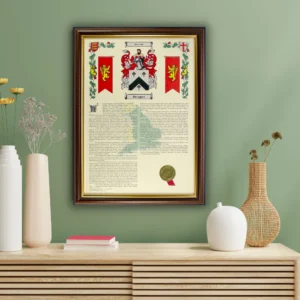
In many cases, you’ll be able to choose from different country origins — for example, “Miller (Scottish)” versus “Miller (German, Dutch, Jewish or English).” Each variation reflects the earliest coat of arms that was recorded for someone of that name in that place. You’ll be able to read a snippet of information about the name, and view the earliest coat of arms.
What if There Is One?
If your name does have a coat of arms on record, you can display it with pride — and we offer many ways to do so. Popular options include:
- Framed surname history scrolls
- Crystal and glassware
- Wooden plaques and shields
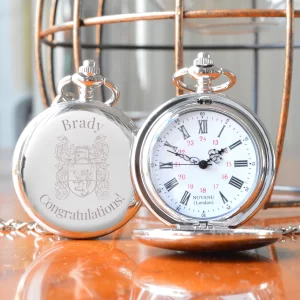
- Homeware gifts such as cushions, a personalised apron, and coasters

Many customers choose these gifts to honour their surname’s history as well as having somethign unique and distinctive as a talking point.
And If There Isn’t?
If your surname doesn’t have a coat of arms listed, that doesn’t diminish the name’s value or interest. In fact, some of our best customers go on to purchase a framed surname history print — even without heraldry — because the story of the name itself is worth celebrating.
Surnames Can Have More Than One Design
Some surnames have several historically recorded heraldic designs linked to different branches, regions, or countries. This is common with widespread names that developed over many centuries. For this reason, heraldry should be approached as part of surname history rather than as one fixed image for every person sharing the name.
Quick Summary
- Coats of arms were historically granted to individuals, not surnames.
- Some surnames became linked to recorded heraldic lines.
- Other surnames may have no surviving formal records.
- Many surnames have more than one associated design.
- Hall of Names researches surname history using records covering over one million names.
Does every surname have a coat of arms?
No. Many surnames have no formally recorded coat of arms, while others may have one or several designs linked to historical bearers of the name.
Why do some common surnames have several coats of arms?
Large surnames often developed in multiple places and family branches, leading to different heraldic associations over time.
If my surname has no coat of arms, does that matter?
Not at all. Surname history includes origins, migration, occupations, spelling changes, and social history beyond heraldry.
Can two unrelated families share the same surname?
Yes. Many surnames arose independently in different areas, so sharing a surname does not always mean shared ancestry.
How can I explore heraldry linked to my surname?
Many people begin with surname history research and historically recorded heraldic references connected with early bearers of the name.
Final Thoughts
Not every surname has a coat of arms, but every name has a story. Whether or not heraldry is part of your surname’s past, there are still countless ways to honour your family name.
Use our Hall of Names name search today to find out what history lies behind yours — you might just discover something fascinating!
If you’d like to pop in and see us, visit our shop in the historic village of Dunster, at the end of High Street. You’ll be able to search for your family name and see its earliest coat of arms on screen.

Leave a Reply