

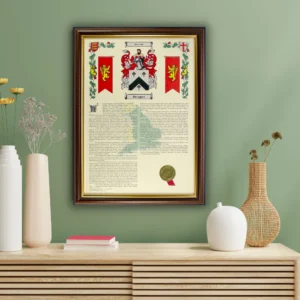





Why do some surnames have more than one coat of arms? The answer lies in how heraldry developed. Historically, coats of arms belonged to individuals rather than entire surnames. Over the centuries, different people with the same surname could acquire, inherit or be granted different heraldic arms.
This often surprises people researching a surname coat of arms for the first time. However, understanding how heraldry worked helps explain why several designs can appear in historical records for the same name.
Quick Summary
- Coats of arms belonged to individuals.
- People sharing a surname were not always related.
- Different family branches could use different heraldic arms.
- New grants of arms were issued over many centuries.
- Several historically recorded arms can be linked to one surname.
Coats of Arms Were Not Created for Surnames
One of the biggest misconceptions about heraldry is the idea that every surname has one official coat of arms.
In reality, coats of arms were granted to individuals. Those arms could pass to descendants according to heraldic rules. However, they did not automatically belong to everyone who happened to share the same surname.
As a result, several heraldic designs may become associated with a single name over time.
Understanding this distinction is important when researching family history and heraldry.
This is one reason why different coats of arms can become associated with a single surname. Here at Hall of Names, our surname history prints feature the earliest coat of arms on record for the name.
Different Family Branches Developed Different Arms
As families grew and spread across the country, separate branches often emerged.
In some cases, younger branches adopted variations of existing arms. In others, entirely new arms were granted. These differences helped distinguish one branch from another while maintaining a connection to the family’s history.
Consequently, historical records often show several heraldic designs connected to the same surname.
Rather than being contradictory, these records reflect the evolution of heraldry over many generations.
Unrelated Families Can Share the Same Surname
Another important factor is that many surnames developed independently.
Occupational surnames such as Smith, Baker and Taylor appeared in many locations. The same happened with place-name surnames and patronymic surnames.
As we discussed in our article Are All People With the Same Surname Related?, sharing a surname does not automatically mean sharing an ancestor.
This also means that different families with the same surname could possess completely different heraldic traditions.
Why Hall of Names Uses the Earliest Recorded Arms
At Hall of Names, historical accuracy is important.
For this reason, our products feature the earliest historically recorded coat of arms associated with a bearer of the surname that we have identified in our research.
This approach provides customers with a historically interesting representation of heraldic heritage while avoiding the misconception that a coat of arms belongs to an entire surname.
The design should be viewed as a historically recorded heraldic association rather than proof of direct descent or ownership.
What About Family Crests?
The word “crest” often causes confusion.
Strictly speaking, the crest forms only one part of a complete heraldic achievement. However, many people use the term “family crest” when referring to an entire coat of arms.
This misunderstanding can sometimes lead people to believe that every surname has one official crest or one official coat of arms.
Historically, the situation was much more complex.
Read The Difference Between a Coat of Arms and Family Crest
Why Historical Context Matters
Heraldry developed over many centuries. During that time, families moved, branches separated and new grants of arms were issued.
As a result, it is perfectly normal to find different coats of arms associated with the same surname in historical records.
Rather than seeing this as a contradiction, it should be viewed as evidence of the rich and varied history behind many names.
At Hall of Names, our database contains over one million surnames, helping visitors explore surname origins, heraldry and family history in a historically responsible way.
Read: Heraldry Symbols Dictionary
Shop: Printed Scrolls
Frequently Asked Questions
Why can one surname have several coats of arms?
Because coats of arms belonged to individuals rather than entire surnames. Different people with the same surname could acquire different arms.
Does everyone with the same surname share the same coat of arms?
No. Sharing a surname does not automatically create a heraldic connection.
Which coat of arms is the correct one?
Several historically recorded coats of arms may exist for a surname. Context and historical records are important.
What coat of arms does Hall of Names use?
We use the earliest historically recorded coat of arms associated with a bearer of the surname identified during our research.
Can multiple coats of arms all be genuine?
Yes. Different historical grants and family branches can create multiple legitimate heraldic designs linked to the same surname.
Visit Us in Dunster
If you would like to learn more about heraldry, surname history and the stories behind your name, we would love to welcome you to our Dunster shop. Our team is always happy to help visitors explore the fascinating world of heraldry.

Leave a Reply