




Are all people with the same surname related? The simple answer is no, not always. While some people who share a surname can trace their ancestry back to a common ancestor, many surnames developed independently in different places and among unrelated families.
This is one of the most common questions asked by people researching their family history. The answer reveals a fascinating story about how surnames developed and spread over time.
Quick Summary
- Some people with the same surname are related.
- Many common surnames developed independently.
- Rare surnames are more likely to indicate a shared ancestry.
- Sharing a surname does not automatically mean sharing a coat of arms.
How Surnames Developed
Most hereditary surnames emerged between the eleventh and fifteenth centuries. As populations grew, communities needed better ways to distinguish between people who shared the same first name.
As a result, surnames often developed from occupations, places, personal characteristics or the name of a parent. Over time, these descriptions became hereditary and passed from one generation to the next.
However, the same surname could arise in multiple locations without any connection between the families involved.
Why Common Surnames Often Have Multiple Origins
Consider the surname Smith. A blacksmith in Yorkshire might become known as John Smith, while an unrelated blacksmith in Devon could receive exactly the same surname.
The same pattern occurred with names such as Baker, Taylor, Cooper and Carter. These occupational surnames appeared wherever the trade existed. Consequently, many people sharing these names today have no direct family connection.
The same principle applies to surnames based on locations. Someone living near a hill, wood or river might acquire a surname linked to that feature. Meanwhile, a completely unrelated family elsewhere could develop the same name.
What About Welsh and Irish Surnames?
Patronymic surnames developed from a father’s first name. Examples include Jones, Williams, Evans and many surnames beginning with Mac or Mc.
Because names such as John, William and Evan were extremely common, many unrelated families adopted the same surname. Therefore, sharing one of these names does not necessarily indicate a common ancestor.
This is particularly important when researching Welsh and Irish heritage, where patronymic naming traditions remained common for many centuries.
Rare Surnames Tell a Different Story
Rare surnames often have fewer points of origin. In some cases, a surname may have originated in a single village, region or family group before spreading more widely.
For this reason, people who share an unusual surname are often more likely to be connected. However, proper genealogical research is still required before drawing conclusions.
https://www.whodoyouthinkyouaremagazine.com/Historical records, census returns, parish registers and family documents all play an important role in confirming family connections. Sites such as Ancestry can help with this, and Magazines like Who Do You Think You Are? and Family Tree Magazine.
Does Sharing a Surname Mean Sharing a Coat of Arms?
This is another common misconception.
Historically, coats of arms belonged to individuals rather than entire surnames or families. Sharing a surname does not automatically give somebody the right to use a particular coat of arms.
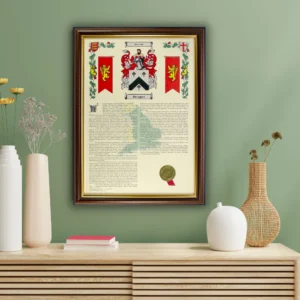
At Hall of Names, our products feature the earliest historically recorded coat of arms associated with a bearer of the surname. These designs provide an interesting insight into heraldic history, but they should not be interpreted as proof of direct ancestry or ownership.
Understanding this distinction helps preserve the historical accuracy of heraldry while allowing people to enjoy the fascinating stories connected to their surname.
View our Surname History Prints Here.
Why Surname History Matters
Researching surname history helps us understand where names came from, how families moved around the country and how communities developed over time.
At Hall of Names, we have spent many years researching surname origins and heraldry. Our database contains over one million surnames, helping customers discover the history, meaning and heritage connected to their name.
Many visitors begin their journey by exploring surname histories and then continue researching their own family tree through historical records and genealogy resources.
Frequently Asked Questions
Are all people with the same surname related?
No. Many common surnames developed independently among unrelated families.
Are people with rare surnames more likely to be related?
Often yes, although proper genealogical research is still needed to confirm a connection.
Can a surname prove I am related to someone?
A surname can provide clues, but it cannot prove a family connection on its own.
Do people with the same surname share a coat of arms?
No. Coats of arms historically belonged to individuals, not entire surnames.
How can I learn more about my surname?
Historical records, genealogy research and surname histories are all useful starting points.
Visit Us in Dunster
If you would like to learn more about surname history, heraldry and family heritage, we would love to welcome you to our Dunster shop. Our team is always happy to help visitors explore the fascinating stories behind their names.


Leave a Reply