




Heraldic symbols have fascinated people for centuries. From lions and eagles to crosses, crowns, and colours, these designs were used to help identify individuals in battle, tournaments, and official life. Over time, many symbols also came to represent qualities such as courage, loyalty, wisdom, or faith. This guide explores the origins of heraldic symbols, how they developed in medieval Europe, and why they remain popular today in surname history gifts and decorative heraldry. Found on coats of arms, these symbols date back to medieval times, when knights, nobles, and later families used them to express values, allegiances, and achievements.
The coat of arms associated with a surname often includes several of these symbols, forming a rich tapestry of historical insight.
At Hall of Names, we use historic surname records to reproduce the earliest recorded coat of arms linked to a bearer of the name — and heraldic symbols play a key part in that story.
(Updated April 2026 with additional FAQs and guidance)

How Heraldic Symbols Began
Modern heraldry developed during the 12th century, when armoured knights needed clear visual identification on shields and surcoats. Bold shapes, animals, colours, and geometric designs could be recognised quickly from a distance. As armour and helmets became more uniform, there was a need for bold, visible identification — both in tournaments and on the battlefield.As heraldry became formalised, many symbols were passed down or adapted through family lines and institutions.Where Did Heraldic Symbols Come From?
Knights began using colourful designs on shields and banners. Over time, these designs were formalised into coats of arms, complete with standardised symbols that conveyed personal and family meaning.
Symbols were soon governed by rules and recorded in registers, making heraldry one of the earliest systems of visual identity.

Why Certain Symbols Became Popular
Many heraldic symbols were chosen because they were easy to recognise and carried strong associations.
Examples include:
- Lion – courage, nobility, strength
- Eagle – authority, vision, power
- Cross – faith and service
- Crown – sovereignty, honour
- Chevron – protection or building achievement
- Fleur-de-lis – purity, devotion, French influence
Meanings could vary by region and period, so heraldry should be seen as symbolic tradition rather than a fixed dictionary. Symbols appear time and again on coats of arms — but their meanings are anything but generic.
Want to explore more? Our dedicated guide explains what heraldic symbols mean on a coat of arms, covering dozens more. You’ll be able to use our easy to navigate A TO Z of symbols, to check against those on your name’s associated coat of arms.
Heraldic Symbols in Britain
Heraldry became especially important in England, Scotland, Wales, and Ireland through royal courts, noble houses, civic bodies, and military traditions. Many surnames are linked to historically recorded coats of arms associated with early bearers of the name. These designs often feature animals, ordinaries, and colours common to British heraldic practice.
Hall of Names specialises in researching surname history and historically recorded heraldic designs associated with surnames, with a database of over one million names.
Why Were Symbols So Important?
Heraldic symbols were more than decorative. In a time when literacy was rare, images spoke louder than words. The lion on a shield immediately declared bravery. A crescent signalled honour. Each coat of arms became a badge of identity — a way to tell your story visually.
Today, they offer a glimpse into the lives, values, and aspirations of those who first bore the name. Even if the spelling of that name changes over the years (Think Shakespeare which is spelt in a variety of ways!)
Coats of Arms and Surnames
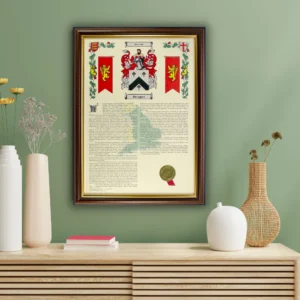
Every coat of arms we feature is based on the earliest historically recorded version associated with a surname — not a personal family crest. These arms include symbols, crests, and sometimes mottos, all of which are carefully preserved in our heraldic records.
You can explore your own name by browsing our range of products featuring these traditional arms, including:
- Framed Coat of Arms Prints
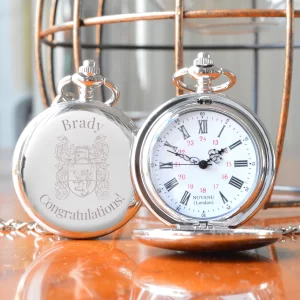
- Crystal & Glass Gifts with Heraldry
- Heraldic Wall Shields & Plaques
- Homeware with Coats of Arms
Celebrate the Symbolism
Heraldic symbols allow us to celebrate a long history of storytelling through images. Whether you’re gifting a crystal tumbler, hanging a shield, or framing your surname scroll, you’re displaying symbols that carry centuries of meaning.
At Hall of Names, we’re proud to preserve this tradition through beautifully crafted, historically accurate products that connect people with their name’s past.
Quick Summary
- Heraldic symbols developed mainly in medieval Europe.
- Symbols helped identify people in armour.
- Animals, crosses, colours, and shapes became common motifs.
- Meanings often reflected ideals such as courage or loyalty.
- Hall of Names offers personalised gifts inspired by historical surname records.
Frequently Asked Questions
What are heraldic symbols?
Heraldic symbols are images, colours, and shapes used in coats of arms and related designs to identify individuals, families, organisations, or places.
When did heraldic symbols begin?
Most historians place the rise of formal heraldry in the 12th century, especially in Western Europe.
Do heraldic symbols always have one meaning?
No. Meanings often changed over time and varied between regions.
Why are lions common in heraldry?
Lions were associated with bravery, leadership, and royal authority, making them popular across Europe.
Can I find heraldic symbols linked to my surname?
Many surnames have historically recorded heraldic designs associated with early bearers of the name, which can be explored through surname history research.
Discover the Heraldry Linked to Your Surname
If you would like to explore the earliest historically recorded coat of arms associated with your surname, Hall of Names offers personalised surname history prints, framed artwork, shields, glassware, and heritage gifts inspired by established heraldic records.
Browse the collection or search for your surname today.

Leave a Reply